Superscales and Layered Harmony Part 1
Inducing Linear Movement with Superscales and Emergent Harmonic Relationships

I’d like to introduce the concept of the “superscale” - a multi-octave extension of a basic interval group, or chord, or harmony where multiple parallel structures are created by starting with a structure within one octave, and transposed up an octave or two (or three), all offset and separated by a the same interval. In the three-octave superscale below, we start with Bmaj7, the add as a continuation the major7 chord a major third higher is continued up an octave, then again. [1]
Fold each of three octaves back down on top of the original octave and you have a one-octave scalar representation of a three-octave superstructure. Below happens to be a twelve-note system that has a D# and an Eb, as well as an A# and a Bb. For our purposes we won’t bother staying enharmonically correct, so it’s OK to say that this scale which starts on B has two D#’s and two A#’s (or vice-versa depending on where you’re hearing it.)
I used a superscale system to help me expand a motif I’d come up with, and I used this as an opportunity to write and improvise within the restrictive and cold boundaries of a theoretical system…something I have always been warned against doing, and something that did feel a little cold at first. But as I messed around with it I found the restrictions forced out some interesting and inspiring relationships.

Ex. 1 The three-octave superscale just one of the possible ways to generate three-dimensional layered harmonic structures and linear movement from within a two-dimensional framework. From this structure notes can be grouped together and combined:
1) Second system above - combining structures and stacking one on top of the other, here one possibility, the Fmi from the second layer/octave, over Ebmin from the first.
2) Third system above - combining similar structures, each in the second “mode” or “position” (what note they start on) in their relative layers/octaves, which when transposed down so all structures are within the same octave, invoke a two-dimensional scale-tone linear system of transformations which reflect the overall superstructure.
My writing process for this was something I’ve never tried – think of the theory before the writing (goes against everything I’ve ever been taught), and make it an additive process as well as a process where I have the intent of pulling this little snippet apart, extend it and really milk as much linear movement as possible.
The superscales come in later – first I wanted to solidify the harmony, and create some shape, and get it under my fingers and in my ears because primarily I wanted to improvise as much of the extended harmony as possible.
I began with a two-bar melody I’d written down – nothing earth-shattering, but I like the way it basically went up, then down, and I also was intrigued by its seeming lack of harmonic implications. I documented each step of the process with a quick recording:
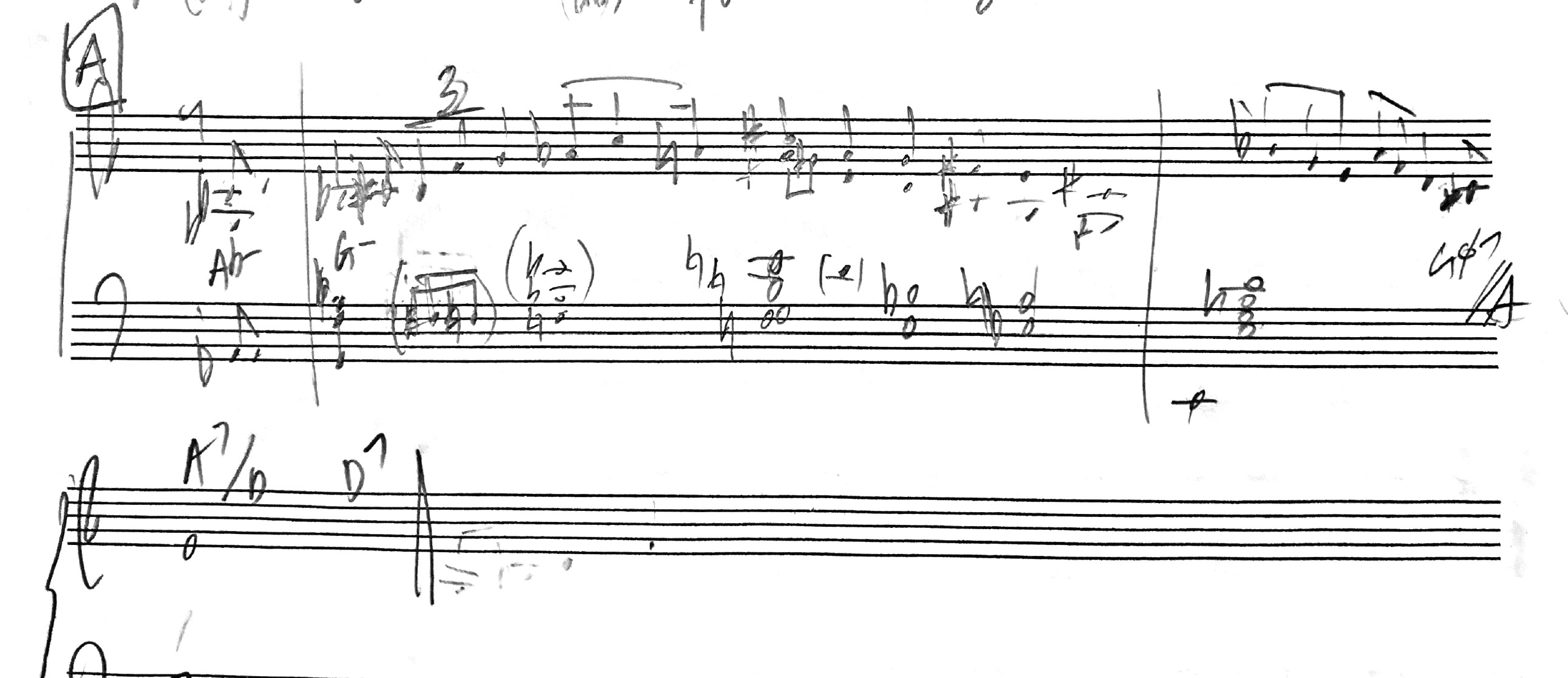
Ex. 2 I harmonized the top line melody with some “ear harmony” just trying to follow the natural contour of rising/tension and falling/resolution. The barline indicates the end of the first gesture. It sounds just enough parallel and antecedent-consequent to be a little interesting and starts to present some cool harmonic implications.
Next step involves getting used to the harmony I’d jotted down, finding some natural-sounding resolutions and movement.
\

Ex. 3 I started fooling around with mid-staff voicings, listening to the inner or middle roots, the F# - F – to E and Eb – definitely hearing some harmonic implications, but nothing too interesting…meh.
Then came more experimentation using some low roots, finding movement, maybe also some diatonic jazz harmony:
Ex. 4 Same as above but now adding low roots, listening to the relationships, moving things around, getting more familiar with it.
Next I split the assembly into three layers, and started pulling it apart – extending duration, finding mini-development from note to note, new note implications. I started messing around with the harmony in layer 2 when I thought it might be interesting to expand each harmonic area into superscales, and thus broaden the project:
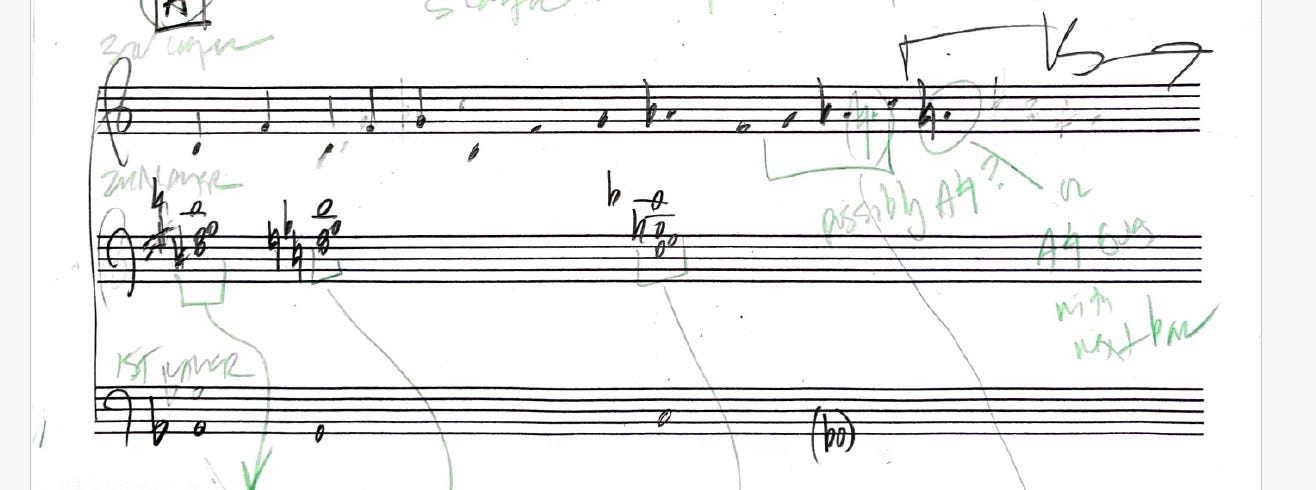
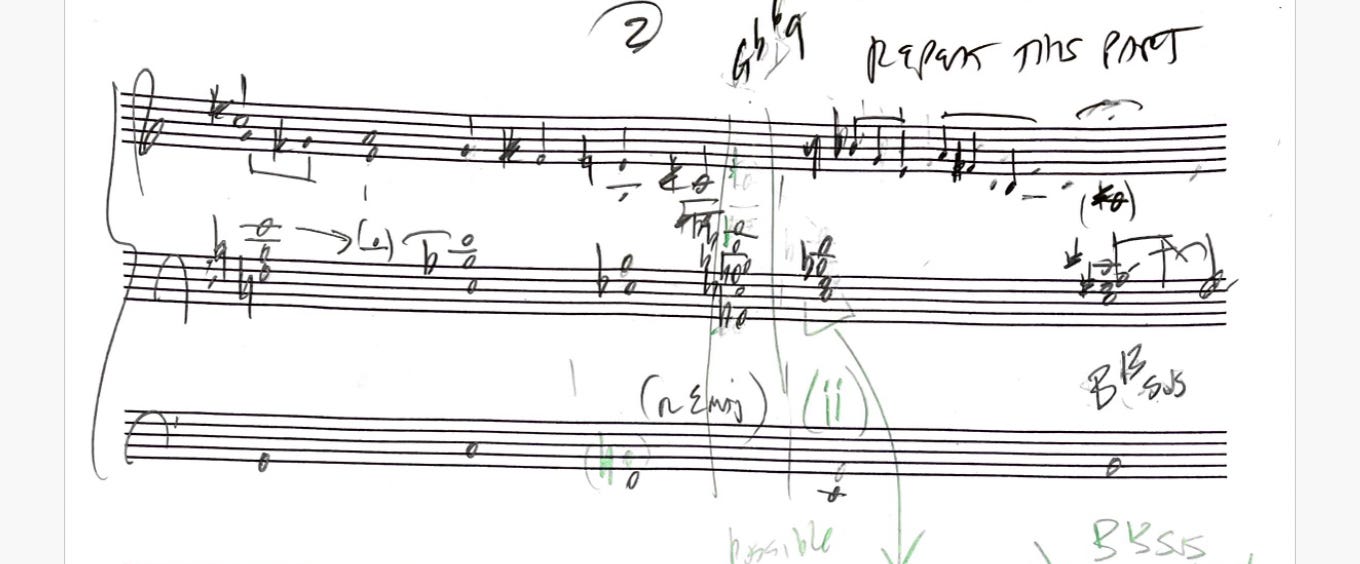
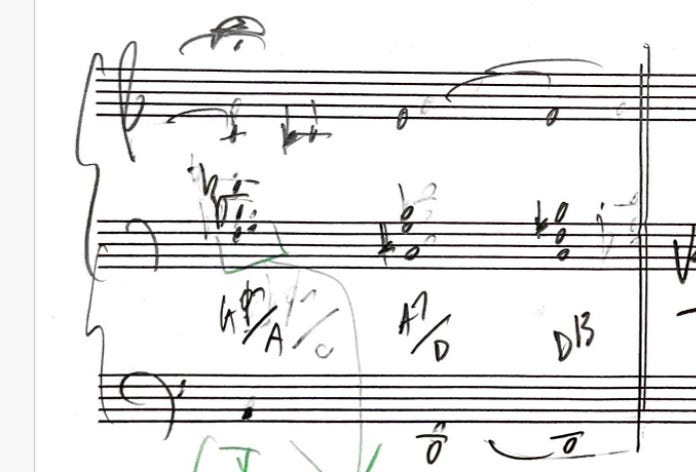
Ex. 5 Improvising extensions of all the melody and harmony yielded interesting movement, additions of notes, finding new chords and more movement within established movement areas. The second layer, the mid-range voicings become the basis for the new superscales which will open this piece up.
Still dealing with the harmony I’ve already established, I added bass notes, followed my ear, trying to get the feel of the harmony under my fingers.
In the next installment I’ll show how I was able to incorporate layered linear harmony using superscales.
[1] I was inspired by some great musical thinkers who also spread structures and scales over multiple octaves, and divided the octave in mysterious ways, like Nicholas Slonimski and his interpolations, infrapolations, and multi-octave arpeggios, George Russell’s harmonic stacking and layering, and Dennis Sandole’s polytonal chord and more importantly polytonal multi-octave scale concept. .